
February 2024
Anthropogenic Aerosols Mask Increases in US Rainfall by Greenhouse Gases
Rain gauge measurements are used to derive data-driven estimates of how climate change impacts extreme precipitation in the United States.
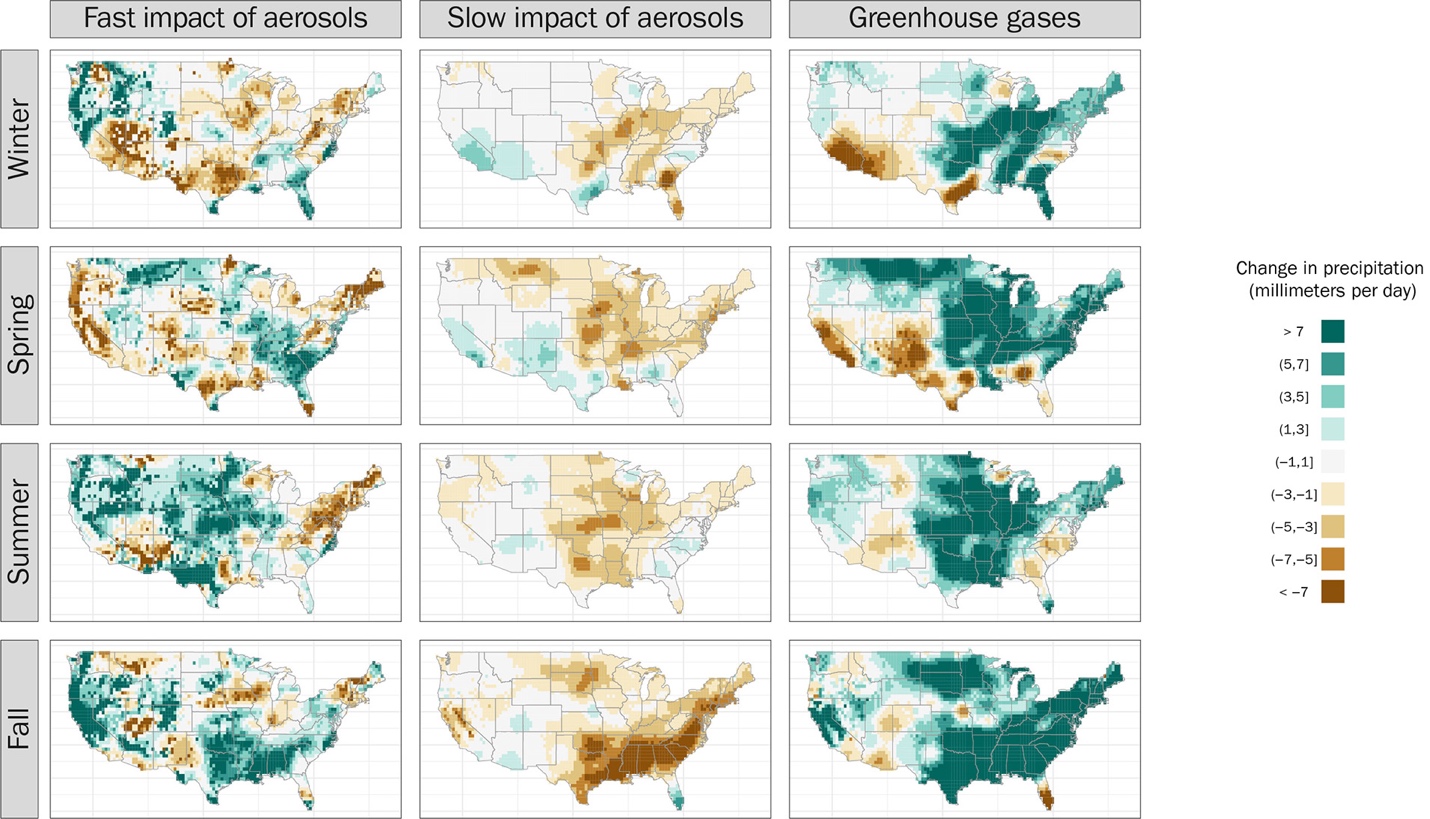
Image courtesy of Mark Risser.
Caption: These maps show how aerosol and greenhouse gas emissions influence extreme rainfall across the seasons. Green indicates an increase in rain, while brown means a decrease.
The Science
Researchers broke down how human-induced greenhouse gas and aerosol emissions influence rainfall in the United States. Greenhouse gases largely increase rainfall across all the seasons, but aerosols work in two ways: the slow impact generally causes drying across the seasons, while the fast impact causes more drying in the winter and spring, and more rain in the summer and fall. In many cases, the offsetting effects of aerosol and greenhouse gas emissions made it appear as though climate change had no impact on precipitation for much of the 20th century.
The Impact
Prior to our study, the Intergovernmental Panel on Climate Change had concluded that the evidence was mixed and inconclusive for changes in seasonal U.S. precipitation due to global warming. We have now provided conclusive evidence for higher rainfall and helped explain why past studies assessed by the IPCC reached conflicting conclusions. Our results furthermore provide guidance for improving future projections of rainfall in the United States, particularly in the summer season.
Summary
A comprehensive understanding of human-induced changes to rainfall is essential for water resource management and infrastructure design. However, at regional scales, existing detection and attribution studies are rarely able to conclusively identify human influence on precipitation. Here we show that anthropogenic aerosol and greenhouse gas (GHG) emissions are the primary drivers of precipitation change over the United States. GHG emissions increase mean and extreme precipitation from rain gauge measurements across all seasons, while the decadal-scale effect of global aerosol emissions decreases precipitation. Local aerosol emissions further offset GHG increases in the winter and spring but enhance rainfall during the summer and fall. Our results show that the conflicting literature on historical precipitation trends can be explained by offsetting aerosol and greenhouse gas signals. At the scale of the United States, individual climate models reproduce observed changes but cannot confidently determine whether a given anthropogenic agent has increased or decreased rainfall.
Contact
(BER PM)
Renu Joseph
SC-23.1
renu.joseph@science.doe.gov, (301) 903-9237
(PI Contact)
William D. Collins
Lawrence Berkeley National Laboratory
wdcollins@lbl.gov, (510) 495-2507
Funding
This research was supported by the Director, Office of Science, Office of Biological and Environmental Research of the U.S. Department of Energy under Contract No. DE-AC02-05CH11231 and by the Regional and Global Model Analysis Program area within the Earth and Environmental Systems Modeling Program. The research used resources of the National Energy Research Scientific Computing Center (NERSC), also supported by the Office of Science of the U.S. Department of Energy, under Contract No. DE-AC02-05CH11231.
Publications
Risser, M.D., Collins, W.D., Wehner, M.F. et al. (2024). Anthropogenic aerosols mask increases in US rainfall by greenhouse gases. Nature Communications 15, 1318. [DOI: https://doi.org/10.1038/s41467-024-45504-8]
LBNL press release: https://newscenter.lbl.gov/2024/02/22/air-pollution-hides-increases-in-rainfall/