
DOE researchers, tools and datasets help to discover a new type of heat wave event, a snow-eater heat wave, that are shown to drive major flood events and exacerbate drought conditions in the mountainous western US. The characteristic changes of these events (e.g., area, duration, frequency, melt potential and seasonality) are identified over the last few centuries.
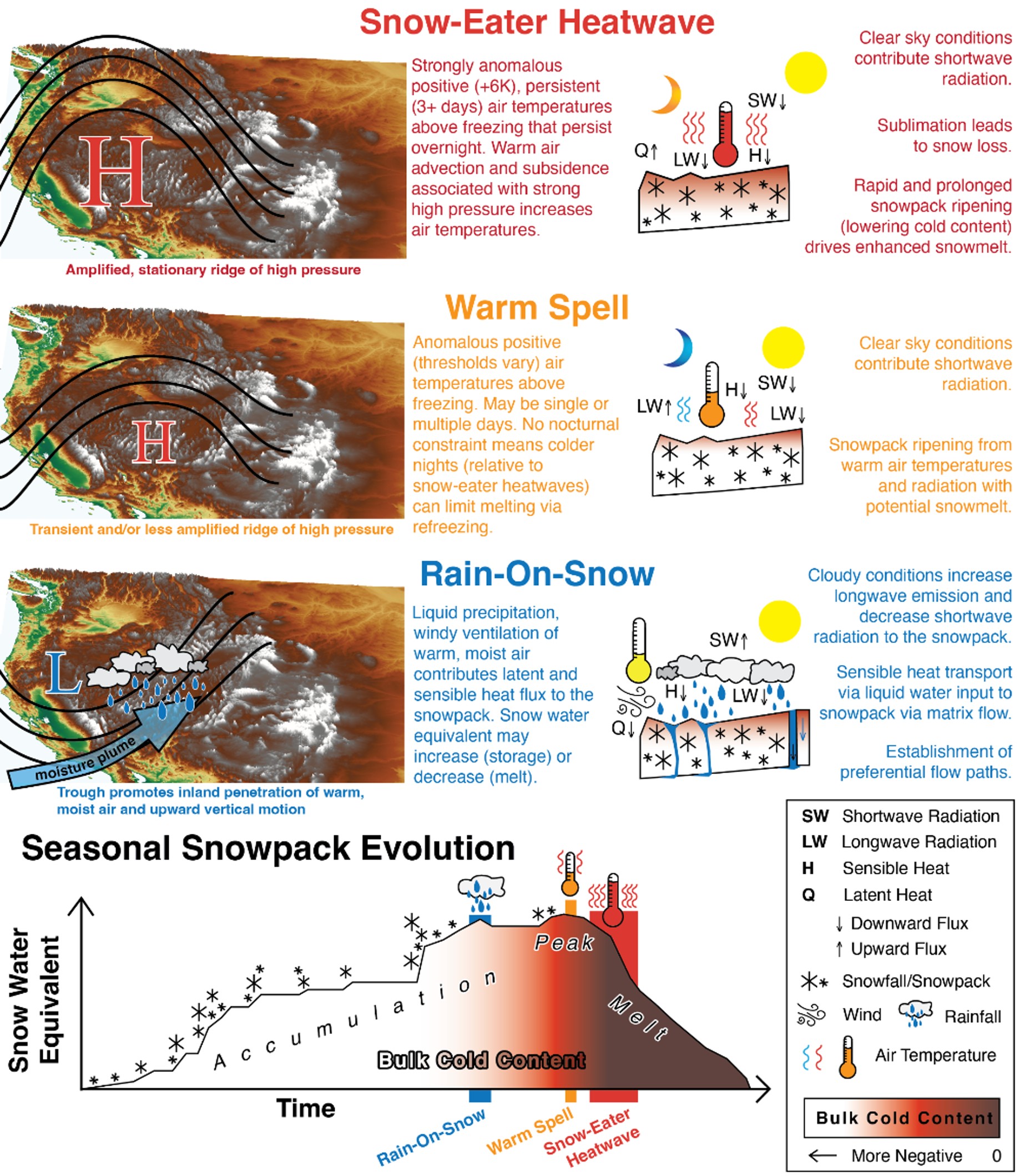
Snow-eater heat waves are distinguished from other major drivers of snowmelt. Snow-eater heat waves exert distinct global-through-local scale energy-mass balance changes to snowpack.
The Science
Snow-eater heat waves are caused by the buildup of anomalous high pressure that diverts storm tracks, acting like a boulder in a stream. The anomalous build-up of high pressure leads to warmer and drier conditions that can lead to sustained above-freezing conditions throughout the day and night. This sustained day and night above freezing and anomalous condition differentiates these events from warm spells. When these snow-eater heat wave conditions persist for several days, snowpack melts twice as fast, on average, as is typically expected. Several identified snow-eater heat waves occurred in close proximity to seven of 11 spring snowmelt-dominated superflood events in the western US.
The Impact
Snow-eater heat waves have occurred often over the last few centuries; however, a particularly impactful one just occurred in March 2026. This event compounded an already dire situation throughout much of the Intermountain West, where drought conditions, particularly snow drought, persisted for most of the winter. After the snow-eater heat wave occurred, the meager amount of mountain snowpack rapidly depleted. This resulted in the second lowest inflows on record to Lake Powell, our nation’s largest reservoir, at a time when Colorado River water managers were hoping for a Miracle March to alleviate stress on the Colorado River compact negotiations. This work provides practitioners with additional information to identify and proactively anticipate snow-eater heat wave impacts.
Summary
Modeling tools that water resource managers often use to estimate processes that shape reservoir inflow estimates are used in this work. More specifically, to better forecast snow-eater heat wave events and their magnified impacts on snowmelt behavior, an operational snowmelt model, SNOW-17, developed by the US Army Corps of Engineers and National Weather Service is combined with datasets and tools, funded in part by the Department of Energy, that provides global weather estimates back to the 1800s and allow for the isolation of particular weather conditions that give rise to snow-eaters. This dataset combines the predictive powers of an Earth system model with, for example, weather measurements made across global shipping routes and at army bases and forts throughout the US. The melt potential model was then optimized, using best practices in Bayesian statistics, to infer potential changes in snowpack measured at longstanding SNOw TELemetry sites throughout the mountainous western US. A few add-ons were proposed for the operational model that would enable it to estimate enhanced melt during snow-eater heat wave events.
Contact
Alan M. Rhoades
Research Scientist, Lawrence Berkeley National Laboratory
arhoades@lbl.gov
Funding
U.S. Department of Energy (DOE) provided research funding for this work through the Director, Office of Science, Office of Biological and Environmental Research out of the CASCADE Science Focus Area (award no. DE-AC02-05CH11231), the HyperFACETS project (award no. DE-SC0016605), and the ARM SAIL campaign (award no. DE-AC02-05CH11231). The NERSC DOE user facility at LBNL (contract no. DE-AC02-05CH11231) enabled this work. External funding for this work, outside of the U.S. DOE, included the National Oceanic and Atmospheric Administration (NOAA) Climate Program Office (CPO) Modeling, Analysis, Predictions, and Projections (MAPP) and National Integrated Drought Information System (NIDIS) programs on the “Understanding Heat Wave–Snow Drought Relationships Across the Western United States” project (award no. NOAA-OAR-CPO-2023-2007440) and the NOAA MAPP-NIDIS project “Towards Predicting Drought and Subsequent Water Resource Challenges at Landscape-Resolving Scales Across the Western U.S.” (award no. NA23OAR4310633-T1-01). Additionally external funding came from the Stanford Doerr School of Sustainability Dean’s Postdoctoral Fellowship from Stanford University and the Agriculture and Food Research Initiative Competitive Grant (award no. 2021-69012-35916) from the USDA National Institute of Food and Agriculture.
Publications
Rhoades, Alan M., Joshua Snowball North, William Rudisill, Benjamin J. Hatchett, Mark Risser, Areidy Beltran-Peña, Anne Heggli et al. “Snow-eater heat waves of the western United States.” Science Advances 12, no. 32 (2026): https://www.science.org/doi/full/10.1126/sciadv.aeb3361