
April, 2024
Decoding the Dynamics of Atmospheric River Clusters
Discover the characteristics of back-to-back atmospheric rivers and the risks they pose in a changing climate.
Credit: Yang Zhou, Lawrence Berkeley National Laboratory
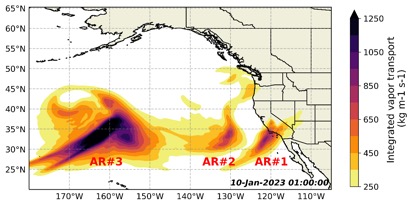
This figure showing a snapshot of three back-to-back ARs ready to hit California. The color represents water vapor through the atmosphere. Darker color means more moisture, which is more likely to lead to intense rainfall.
The Science
Atmospheric rivers are like rivers in the sky that carry vast amounts of water vapor. When these meet land, they often result in heavy rains and flooding. Recently, researchers used a machine learning tool to study these phenomena, particularly focusing on groups or ‘clusters’ of these rivers. They found that clusters with densely-packed atmospheric rivers are more likely to lead to more severe weather events. This study also discuss how these clusters will change with the warming climate.
The Impact
Understanding atmospheric river clusters is crucial for preparing for and mitigating future climate risks. This research helps predict when and where such cluster of weather extremes might hit, allowing for better flood defenses and emergency responses. As our climate changes, this cluster may occur more often and become even more damaging. Therefore, insights from this study become essential to protect communities and infrastructure, especially in regions prone to extreme weather.
Summary
This study utilized advanced machine learning algorithms to analyze the characteristics and impact of atmospheric river clusters—groups of intensive moisture transport systems that can significantly increase flood risk. By examining these clusters, the research revealed that denser clusters are associated with more frequent high-category atmospheric river events, leading to heightened risks of extreme precipitation and harsh land responses. The study connect the cluster activity to large-scale atmosphere circulations and identify a large-scale pattern that is favorable for clusters to occur. The study demonstrates that the atmospheric river clusters will be more frequent and impactful in the future. Such findings are vital as they enhance our ability to predict such weather extremes and to better prepare for potential natural disasters, contributing to improved resilience strategies.
Contact
Yang Zhou
Lawrence Berkeley National Laboratory
yzhou2@lbl.gov
Funding
This study was funded by the Director, Office of Science, Office of Biological and Environmental Research of the U.S. Department of Energy Regional and Global Climate Modeling Program (RGMA) “Calibrated and Systematic Characterization, Attribution and Detection of Extremes (CASCADE)” Science Focus Area (award no. DE-AC02-05CH11231).
Publications
Zhou, Y., Wehner, M. & Collins, W. Back-to-back high category atmospheric river landfalls occur more often on the west coast of the United States. Commun Earth Environ 5, 187 (2024). https://doi.org/10.1038/s43247-024-01368-w
Unraveling the Mysteries of Consecutive Atmospheric River Events, News from Berkeley Lab