
January 2025
Drivers of Atlantic tropical cyclogenesis: African easterly waves and the environment
Favorable environments play a larger role than wave strength for African easterly waves (AEWs) to develop into Atlantic tropical cyclones (TCs).
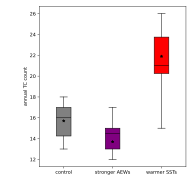
Image courtesy of Bercos-Hickey and Patricola (2025).
Boxplots of the annual Atlantic TC count for ten ensembles of the control (gray), stronger AEW experiment (purple), and warmer SSTs experiment (red). Stars show the ensemble mean.
The Science
African easterly waves (AEWs) are precursors to Atlantic tropical cyclones (TCs). Previous studies have examined how AEWs and the environment affect TC genesis, however their relative importance is less understood. In this research, we examine whether AEW strength or sea surface temperatures (SSTs) are the primary drivers of TC genesis. Using a 10-member ensemble of regional model simulations, we found that environmental favorability plays a larger role than AEW strength in driving the frequency of TCs that develop from AEWs.
The Impact
Atlantic TCs can be both deadly and destructive, and understanding what drives these storms is essential for improving storm prediction and preparedness. TC development requires favorable environmental conditions, as well as some type of initial disturbance, which is often an AEW in the North Atlantic. In this study, we used regional model simulations to examine how AEW strength and warm sea surface temperatures (SSTs) would affect the 2002 Atlantic hurricane season, which had below-average AEW strength and anomalously cool SSTs. We found that favorable environmental conditions play a larger role than AEW strength in driving the frequency of TCs that develop from AEWs. Strengthening the AEWs did not affect the frequency of AEWs that develop into TCs due to low environmental favorability. Warmer SSTs led to increased environmental favorability and a statistically significant increase in TCs that develop from AEWs. These results demonstrate the importance of understanding the combined factors that lead to TC formation in the Atlantic.
Summary
In this study, we examined whether TC genesis is primarily driven by AEW characteristics or the environment by specifically focusing on AEW strength and SSTs. To conduct this research, we ran a suite of regional model simulations for the 2002 Atlantic hurricane season, which notably had below-average AEW strength and anomalously cool SSTs, as well as a below-average number of TCs that developed from AEWs. We found that stronger AEWs did not lead to a statistically significant increase in TCs that develop from AEWs, likely due to unfavorable environmental conditions, including cool SSTs and increased vertical wind shear. In contrast, warmer SSTs led to a statistically significant increase in TCs and TCs that develop from AEWs, likely due to increased environmental favorability.
Contact
Emily Bercos-Hickey
Lawrence Berkeley National Laboratory
ebercoshickey@lbl.gov
Funding Program Area(s)
RGMA
Funding
· Calibrated and Systematic Characterization, Attribution, and Detection of Extremes (CASCADE) Scientific Focus Area
o Award Number DE-AC02-05CH11231
· Variability and Change in Tropical Cyclone Characteristics: Coupled Atmosphere-Ocean Drivers and Coastal Impacts
o Award Number DE‐SC0021109
· National Energy Research Scientific Computing Center (NERSC)
o Contract No. DE-AC02-05CH11231
Publications
Bercos-Hickey, E. & Patricola, C.M. (2025) Drivers of Atlantic Tropical Cyclogenesis: African Easterly Waves and the Environment. Geophysical Research Letters, 52, e2024GL112002.
[DOI: 10.1029/2024GL112002]