
April 2025
Performance Evaluation of Weather@home2 Simulations over West African Region
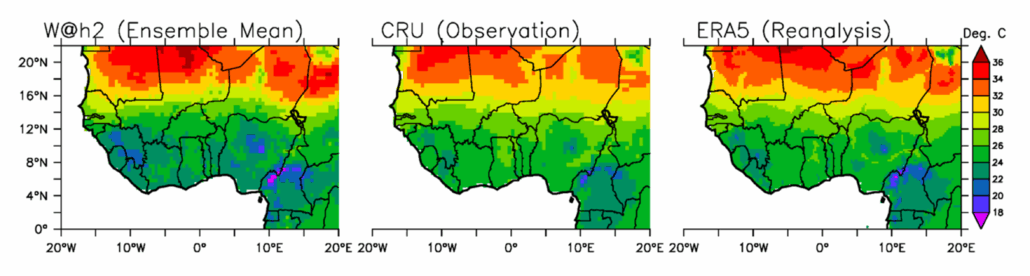 Mean spatial distributions of near-surface maximum temperature (shaded; °C) over West Africa for the month of August: (left) w@h2 ensemble mean simulation, (middle) CRU- observation, and (right) ERA5-reanalysis.
Scientific Challenge: West Africa is a region with high climate variability, making it challenging to predict weather patterns and understand climate change. The region’s climate is influenced by various factors, including the Inter-Tropical Discontinuity (ITD) and the El Niño Southern Oscillation (ENSO). Accurate climate predictions are essential for the region’s agriculture, water resources, and economic development. However, current climate models have limitations, and evaluating their performance is crucial for improving predictions.
Approach and Findings: Researchers used statistical methods to evaluate the performance of climate models in West Africa. They applied metrics such as the Brier score to assess the accuracy of model predictions, particularly for extreme weather events. The results showed that these metrics are effective in identifying large errors and outliers, which can help improve model accuracy. The study also explored the impact of sea surface temperature anomalies in the Gulf of Guinea on West Africa’s climate. The findings highlighted the importance of considering regional climate mechanisms, such as the ITD and the African Easterly Jet, in improving climate predictions.
Significance and Impact: The findings of this study have significant implications for West Africa’s climate resilience and sustainable development. By improving climate predictions, policymakers and stakeholders can make informed decisions about agriculture, water resources, and disaster risk reduction. The study’s results can also contribute to the development of early warning systems for extreme weather events, such as droughts and floods, which are common in the region. Additionally, the research can inform climate change adaptation and mitigation strategies, ultimately helping to reduce the region’s vulnerability to climate-related hazards and promote sustainable development.
Contact
Michael F. Wehner
Lawrence Berkeley National Laboratory
mfwehner@lbl.gov
Funding
This material is partially based upon work supported by the U.S. Department of Energy, Office of Science, Office of Biological and Environmental Research, Climate and Environmental Sciences Division, Regional & Global Model Analysis Program as part of the CASCADE SFA and used resources of the National Energy Research Scientific Computing Center (NERSC), also supported by the Office of Science of the U.S. Department of Energy under Contract Number DE-AC02-05CH11231 and under award Number DE-SC0023519
Publications
Lawal, K.A.; Akintomide, O.M.; Olaniyan, E.; Bowery, A.; Sparrow, S.N.; Wehner, M.F.; Stone, D.A. Performance Evaluation of Weather@home2 Simulations over West African Region. Atmosphere 2025, 16, 392. https://doi.org/10.3390/atmos16040392