
October 2025
Simulating Hurricane Katrina in the Simple Cloud-Resolving E3SM Atmosphere Model v1
SCREAMv1 at 3.25 km realistically simulated Hurricane Katrina with respect to track, size, and intensity.
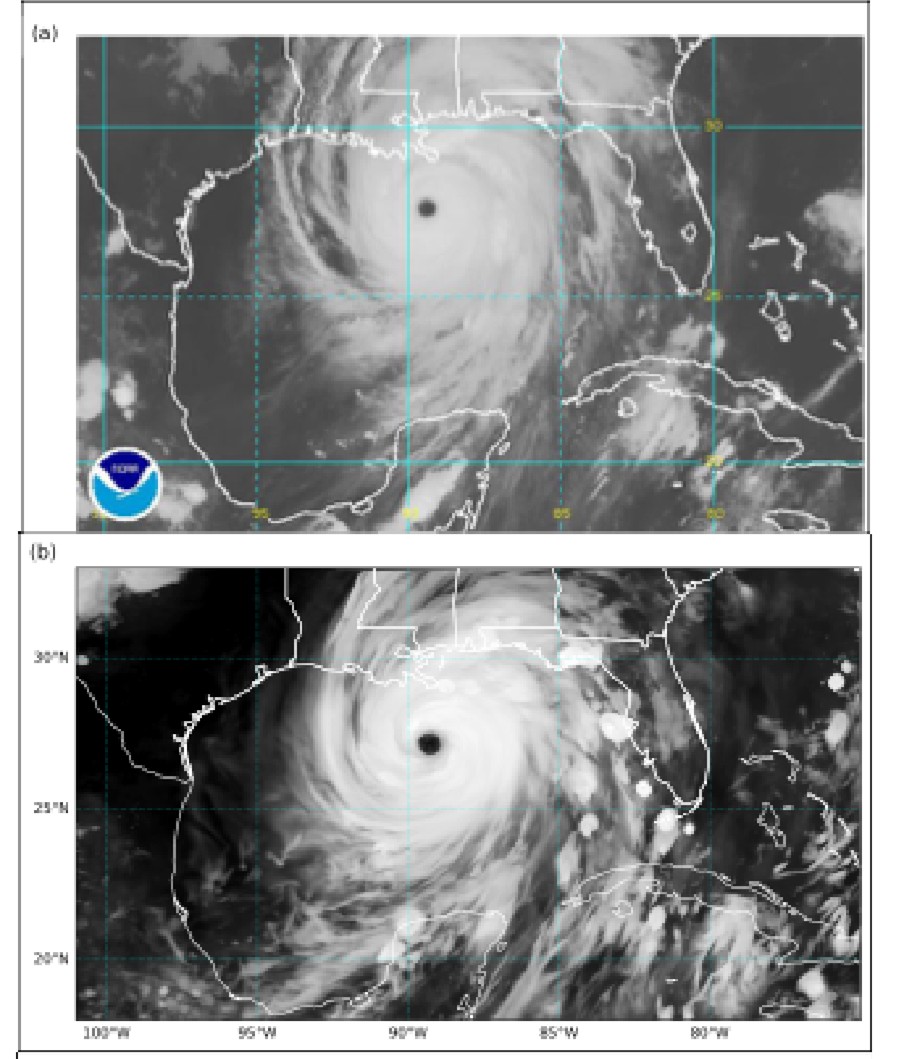
Hurricane Katrina from (a) the GOES‐EAST unenhanced infrared at 2:45 UTC on 29 August 2005, and (b) outgoing longwave radiation (OLR) from one ensemble member of SCREAMv1 at 3:00 UTC on 29 August 2005. OLR is shown between 80 and 300 W m-2. Image courtesy of Bercos-Hickey et al. (2025).
The Science
Earth system models are important tools for developing better understanding and predictability of tropical cyclones (TCs). Traditional models, however, do not have the ability to properly simulate TC intensity due to their coarse horizontal resolution. Regional models can be run at convection‐permitting resolutions, but these models are often strongly influenced by the lateral boundary forcing and the domain choice. In this study, we use the Simple Cloud‐Resolving Energy Exascale Earth System Model (E3SM) Atmosphere Model (SCREAM) v1 run globally at 3.25 km spatial resolution to demonstrate its skill in simulating a historically impactful tropical cyclone, Hurricane Katrina.
The Impact
TCs can be both deadly and destructive, and it is therefore vitally important to ensure that Earth system models can accurately simulate TCs to improve our forecasting abilities and mitigate risk.
Traditional, coarse resolution global models are unable to accurately simulate TC intensity, which is problematic given that the proportion of TCs which become major hurricanes has significantly increased in the past decades. In this study, we use the SCREAMv1 model at a global, convection-permitting resolution of 3.25 km to assess model skill in simulating Hurricane Katrina. We found that SCREAMv1 produces a realistic simulation of Hurricane Katrina that is in good agreement with the observational record with respect to TC track, size, and, notably, intensity. This research has established that SCREAMv1 demonstrates skill in simulating the characteristics of a historically impactful TC and we expect that this will be useful for future TC simulations that may explore TC processes that are more realistically represented by SCREAMv1 than traditional, coarser resolution models. In the face of increasing rates of TC rapid intensification and TC damages, it is critically important to realistically simulate TCs for improved predictability.
Summary
In this study, we used SCREAM v1 at 3.25 km globally to examine the its ability to simulate a historically impactful TC. We evaluated SCREAMv1 against the observational record and the Weather Research and Forecasting (WRF) model run at a convection‐permitting resolution with Hurricane Katrina as our case study. We found that both models produced realistic simulations of Hurricane Katrina. SCREAMv1 demonstrated skill in simulating TC track, size, and intensity, while the model produced an excessive amount of precipitation. In comparison, WRF more accurately simulated TC precipitation and intensity, although the TC wind extent was smaller than the observations. Our study shows that SCREAMv1 is a promising new model for TC simulations, with results that are comparable to WRF, a well-established model, and the observational record.
Contact
Emily Bercos-Hickey
Lawrence Berkeley National Laboratory
ebercoshickey@lbl.gov
Funding Program Area(s)
RGMA
Funding
- Calibrated and Systematic Characterization, Attribution, and Detection of Extremes (CASCADE) Scientific Focus Area, Award Number DE-AC02-05CH11231, https://climatemodeling.science.energy.gov/projects/calibrated-and-systematic-characterization-attribution-and-detection-extremes-cascade
- Variability and Change in Tropical Cyclone Characteristics: Coupled Atmosphere-Ocean Drivers and Coastal Impacts, Award Number DE‐SC0021109 https://climatemodeling.science.energy.gov/projects/variability-and-change-tropical-cyclone-characteristics-coupled-atmosphere-ocean-drivers
- National Energy Research Scientific Computing Center (NERSC) Contract No. DE-AC02-05CH11231
- Lawrence Livermore National Laboratory Contract No. DE- AC52‐07NA27344
- Pacific Northwest National Laboratory Contract No. DE-AC06‐76RLO1830
Publications
Bercos-Hickey, E., Mahfouz, N., Keen, N. D., Patricola-DiRosario, C. M., Hannah, W. M., Beydoun, H. Wehner, M. F., Lin, W., Terai, C. R., and Hillman, B. (2025) Simulating Hurricane Katrina in the Simple Cloud-Resolving E3SM Atmosphere Model V1. Journal of Advances in Modeling Earth Systems, 17, e2025MS005210.
[DOI: 10.1029/2025MS005210]