
July 1, 2025
The effect of African easterly wave suppression by periodicity on Atlantic tropical cyclones
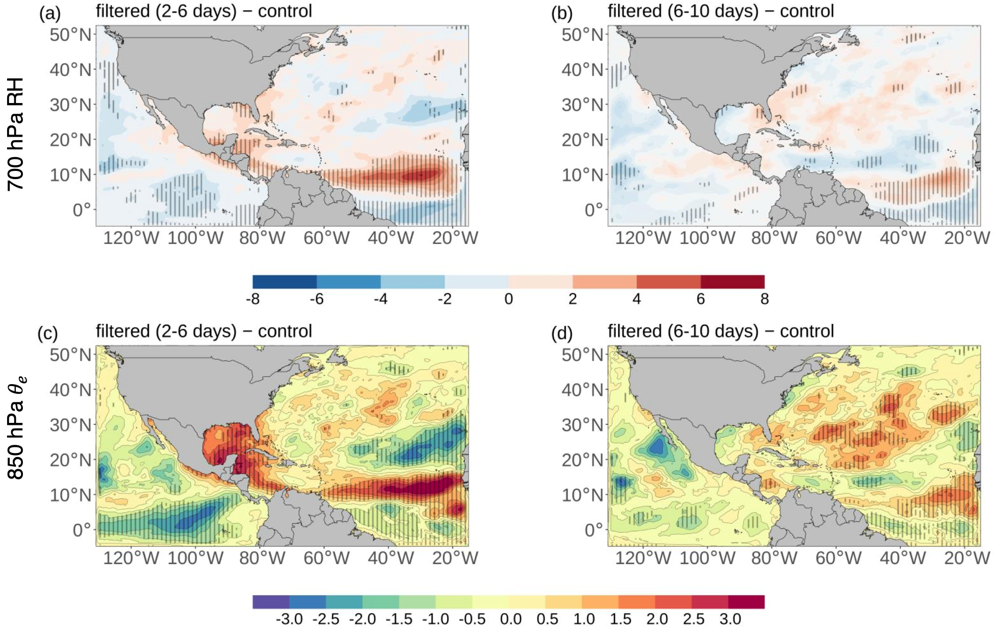
Simulated ensemble-mean June–November averaged (top) 700 hPa relative humidity (%) and (bottom) 850 hPa equivalent potential temperature (K) for (a, c) the 2–6-day filtered experiment minus the control, and (b, d) the 6–10-day filtered experiment minus the control. Hatching indicates statistically significant differences (p < 0.05).
The Science
African easterly waves (AEWs), the main precursor of North Atlantic tropical cyclones (TC), are classified into two types based on their periodicity. We investigated the role of each AEW periodicity range on seasonal TC activity and associated environmental conditions. We performed a 10-member ensemble of TC-permitting regional climate model experiments in which the 2–6-day and 6–10-day AEWs are separately removed from or prescribed in the lateral boundary condition.
The Impact
Suppressing 2–6-day AEW activity significantly increased seasonal TC frequency. It also enhanced mid-tropospheric relative humidity by up to 8% and strengthened atmospheric instability, leading to more intense convective disturbances with stronger vortices and higher rainfall. This suggests that weakened 2–6-day AEW activity creates a more favorable environment for TCs.
Summary
Research has shown that suppressing African easterly waves (AEWs) does not reduce basin-wide North Atlantic tropical cyclone (TC) frequency but can enhance TC environmental favorability. We investigated the AEW-TC relationship further by examining the effects of suppressing the two AEW periodicities individually on TC activity. Using 10-member ensembles of regional model simulations, AEWs were prescribed or suppressed in the 2–6-day or 6–10-day ranges through the lateral boundary conditions. Seasonal TC frequency increased significantly when either AEW periodicity was suppressed, with a larger increase when the 2–6-day waves were suppressed. We also found that suppressing the 2–6-day waves increased mid-tropospheric relative humidity by up to 8%, as well as overall atmospheric instability, near the western coast of northern Africa. Furthermore, the convective disturbances that developed into TCs exhibited stronger rotation, increased ascending motion, and higher rainfall. Our results suggest that reduced 2–6-day AEW activity may trigger a more active TC season.
Contact
Christina Patricola
Iowa State University
Funding
This work was supported by the U.S. Department of Energy, Office of Science, as part of research in Regional and Global Model Analysis, Earth and Environmental System Modeling Program under Contract No. DE340AC02-05CH11231 through the Calibrated and Systematic Characterization Attribution and Detection of Extremes (CASCADE) Scientific Focus Area.
Publications
Danso, D. K., Patricola, C. M., Bercos-Hickey, E., & Lavaysse, C. (2025). The effect of African Easterly Wave suppression by periodicity on Atlantic tropical cyclones. Environmental Research Letters, 20(8), 084018. https://doi.org/10.1088/1748-9326/ade609