
January 2025
Understanding Runoff by Atmospheric Rivers
How Moisture in the Atmosphere Impacts Runoff on the West Coast
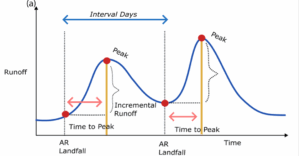
Image courtesy of William Rudisill.
Schematic plot showing how the runoff curve is affected by atmospheric river landfalls.
The Science
The study found that weaker atmospheric rivers can cause significant runoff if they occur when the soil is already wet or the snow is ready to melt. When atmospheric rivers occur close together, the runoff from the second one is often much higher because the land has not had enough time to release the water brought by the first one. This “back-to-back” effect is expected to become more frequent with climate warming.
The Impact
The findings have significant implications for predicting flood risks and developing models for atmospheric river-induced runoff. The study highlights the importance of including soil moisture and snowpack levels in impact assessments. As climate warming increases the frequency of back-to-back atmospheric rivers, the risk of flooding also increases. This knowledge can help inform decision-making and mitigation strategies to reduce the impact of flooding on communities and ecosystems.
Summary
Atmospheric rivers are narrow bands of concentrated moisture in the atmosphere that can bring heavy rain when they reach land. The study investigated the relationship between atmospheric river characteristics, such as intensity and landfall coupling frequency, and the resulting runoff response on land. The researchers found that antecedent land surface conditions, such as soil moisture and snowpack, play a crucial role in determining the impact of atmospheric rivers on runoff. The study also showed that the timing of atmospheric river landfalls is critical, with shorter intervals between landfalls leading to increased runoff. These findings can help improve predictions of flood risk and inform strategies for managing water resources and mitigating the impacts of flooding.
Contact
Yang Zhou
Research Scientist, Lawrence Berkeley National Laboratory
Yzhou2@lbl.gov
Funding
This study was funded by the Director, Office of Science, Office of Biological and Environmental Research of the U.S. Department of Energy Regional and Global Climate Modeling Program (RGMA) and MultiSector Dynamics Program Areas under contract DE-AC02-05CH11231, by “Calibrated and Systematic Characterization, Attribution and Detection of Extremes (CASCADE)” and “Reducing Uncertainties in Biogeochemical Interactions through Synthesis and Computation (RUBISCO)” Science Focus Areas. This study is also funded by the “An Integrated Evaluation of the Simulated Hydroclimate System of the Continental US” (HyperFACETS) project (award DE-SC0016605) and the Atmospheric System Research Program.
Publications
Zhou, Y., et al. Atmospheric river frequency-category characteristics shape U.S. West Coast runoff. Journal of Geophysical Research: Atmospheres, 130, e2024JD041805 (2025). [https://doi.org/10.1029/2024JD041805].