
March 2025
Unprecedented Heatwaves: Statistical Analysis and Upper Bounds
Understanding Extreme Weather Events Through Advanced Modeling
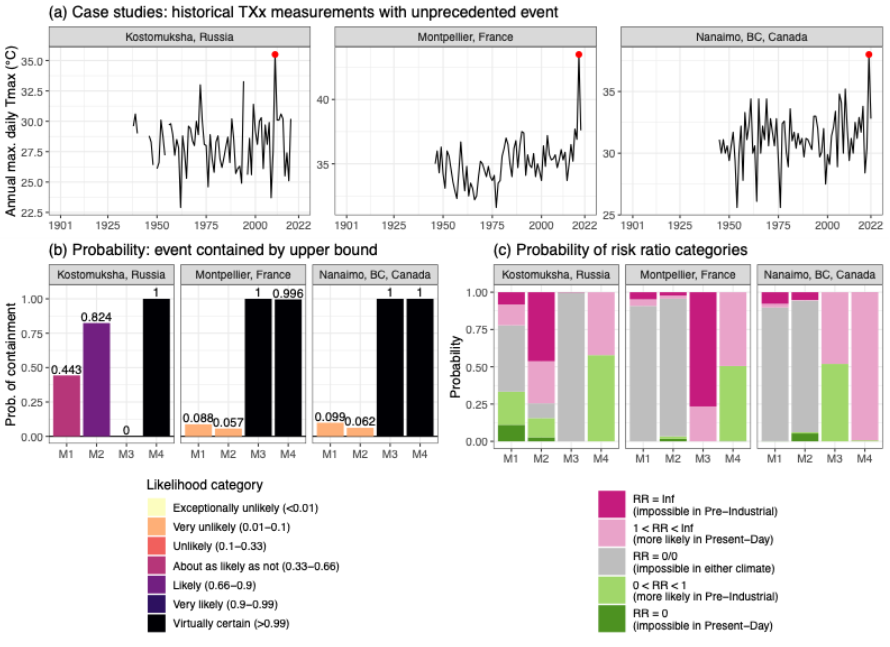
Image courtesy of Mark Risser.
A preview of our results for three unprecedented heatwaves, showing unprecedented events (panel a), probability that the event could be anticipated (panel b.), and comparing the likelihood of events in a pre-industrial vs. present-day climate (panel c.). Labels M1-M4 refer to different statistical methods, ranging from more traditional (M1 and M2) to more state-of-the-art (M3 and M4). Darker colors in panel (b) indicate better performance of the statistical methods.
The Science
The study analyzes unprecedented heatwaves in the 19th and 20th centuries, estimating their probabilities and statistical properties. It uses various models to determine the likelihood of these extreme events, finding that state-of-the-art methods are more effective in containing observed temperatures. The research also develops an online tool for users to explore specific heatwave events, offering insights into return levels, risk probabilities, and containment likelihoods. This analysis helps in understanding the dynamics of extreme heatwaves.
The Impact
The findings are crucial for improving climate models and predicting future extreme heat events. By providing non-zero probability estimates for unprecedented events, the study enhances the robustness of statistical analysis. This knowledge is vital for policymakers and climate scientists to develop strategies for mitigating the impacts of extreme weather. The online tool further aids in the dissemination of this information, making it accessible to a broader audience.
Summary
The manuscript presents a comprehensive analysis of unprecedented heatwaves from the last century. It employs different statistical models to estimate the likelihood of these extreme events, with state-of-the-art methods showing superior performance. The study also introduces an online graphical user interface, allowing users to explore specific heatwave events based on customized parameters. This tool provides detailed information on return levels, risk probabilities, and containment likelihoods, enhancing the understanding of extreme weather dynamics. The authors emphasize the importance of spatial analysis when introducing multiple covariates, as it can lead to better containment probabilities of unprecedented events. The study’s findings are significant for improving climate models, predicting future extreme heat events, and aiding in the development of effective mitigation strategies.
Contact
(BER PM)
Renu Joseph
SC-23.1
renu.joseph@science.doe.gov, (301) 903-9237
(PI Contact)
William D. Collins
Lawrence Berkeley National Laboratory
wdcollins@lbl.gov, (510) 495-2507
Funding
This research was supported by the Director, Office of Science, Office of Biological and Environmental Research of the U.S. Department of Energy under Contract No. DE-AC02-05CH11231 and by the Regional and Global Model Analysis Program area within the Earth and Environmental Systems Modeling Program. The research used resources of the National Energy Research Scientific Computing Center (NERSC), also supported by the Office of Science of the U.S. Department of Energy, under Contract No. DE-AC02-05CH11231.
Publications
Risser, M.D., Zhang, L., Wehner, M.F. (2025) Data-driven upper bounds and event attribution for unprecedented heatwaves. Weather and Climate Extremes, https://doi.org/10.1016/j.wace.2025.100743
Graphical user interface: https://mark-risser.shinyapps.io/impossible-temperatures/