
April 2026
Using Machine Learning-based Weather Model Emulators to Quantify Weather Extremes
Statistical techniques allow one to quantify weather extremes using large ensembles produced from machine-learning based weather model.
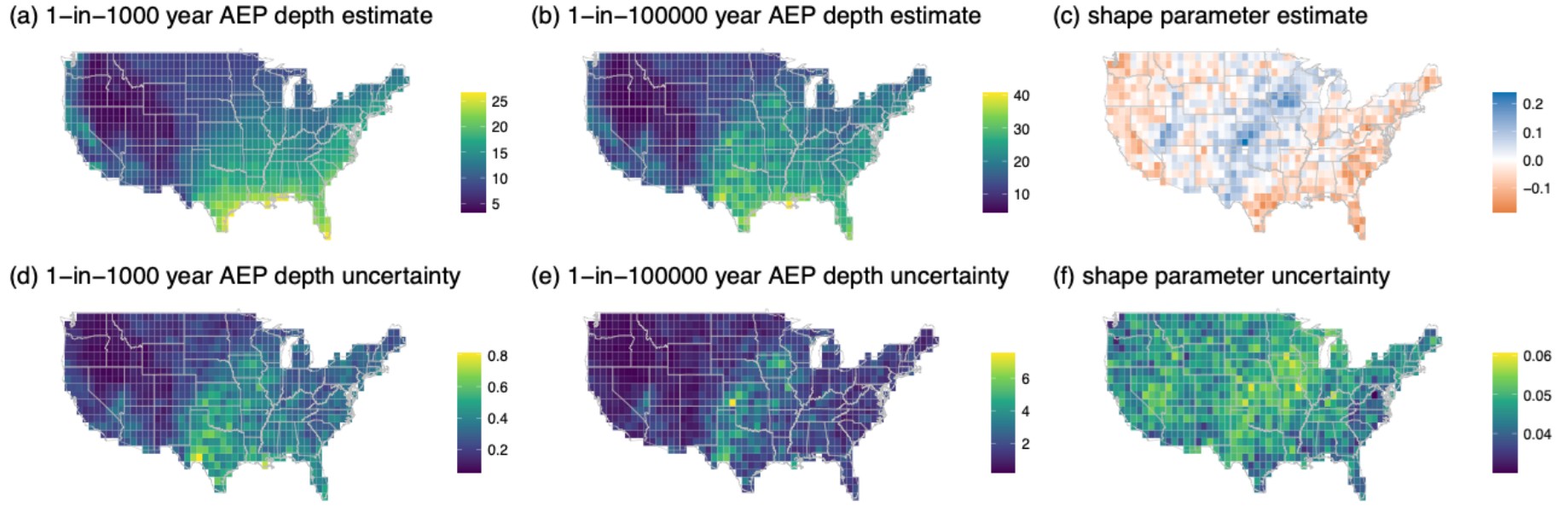
Emulator-based extreme precipitation estimates: (a) 1-in-1000 year precipitation (cm) estimates, (b) 1-in-100000 year precipitation (cm) estimates, (c) extreme value model shape parameter estimates, with corresponding standard error estimates (d), (e), and (f), respectively. Image courtesy of Paciorek and Cooley (2026) BAMS.
The Science
Weather extremes produce major impacts on society and ecosystems. Machine learning now provides methods to simulate weather for many hypothetical years at much lower computational expense than traditional weather models. This provides the opportunity to estimate the magnitude of events that are very unlikely to occur using statistical methods applied to the simulation output, for use in planning, risk assessment, and adaptation. In our work, we investigated how to best use statistical methods designed for extreme values to analyze the output from such machine learning methods.
The Impact
Our work finds that when used appropriately, statistical methods designed to analyze extremes can reliably estimate the magnitude of extremely high precipitation and temperature events in the United States, under the critical assumption that the machine learning method is a good mimic of real world weather. Our work provides a suggested methodology that meteorological scientists, in particular the US National Oceanic and Atmospheric Administration, can use to produce estimates of extremes that can be used to those assessing the safety of critical infrastructure.
Summary
Weather extremes produce major impacts on society and ecosystems. However, very low probability events are hard to characterize statistically using observations or even weather model output because of short records/runs. For precipitation, consideration of such events arises in quantifying Probable Maximum Precipitation (PMP), namely estimating extreme precipitation magnitudes for designing and assessing critical infrastructure. A recent National Academies report on modernizing PMP estimation proposed using very large weather model-based ensembles to estimate extreme quantiles, possibly through machine learning-based ensemble boosting. Here we assess statistical aspects of such an approach for the contiguous United States using a huge ensemble (10560 years) produced by a state-of-the-art emulator (ACE2) trained on ERA5 reanalysis. The results indicate that one can practically estimate very extreme precipitation and temperature quantiles, provided one uses appropriate statistical extreme value techniques. More specifically, the results provide evidence for (1) the use of threshold-exceedance methods with a sufficiently high threshold (necessary for precipitation) for reliable estimation, (2) the robustness of results to variation in extremes by season and storm type, and (3) the sufficiency of the ensemble for well-constrained statistical uncertainty.
Contact
Christopher Paciorek
Department of Statistics, UC Berkeley
paciorek@berkeley.edu
Funding
This research was supported by the Director, Office of Science, Office of Biological and Environmental Research of the U.S. Department of Energy through the CASCADE SFA and by the National Science Foundation.
Publication
Paciorek, C.J. and D. Cooley. “Quantifying Very Extreme Precipitation and Temperature Using Huge Ensembles Generated by Machine Learning-based Climate Model Emulators.” Bulletin of the American Meteorological Society. (2026) [https://doi.org/10.1175/BAMS-D-25-0178.1]